

Why Will Augmented Reality Kill the Hologram?
The pursuit of holograms is one of the most anticipated dreams for those who follow science fiction movies. Despite the limited success of existing holographic technologies,
Why Will Augmented Reality Kill the Hologram?
The pursuit of holograms is one of the most anticipated dreams for those who follow science fiction movies. Despite the limited success of existing holographic technologies, the advancement of virtual and augmented reality promises to achieve a true transposition of 3D into the real world. Check it out!
Everyone who has watched the Star Wars movies has considered the possibility of receiving a holographic "call" like Master Yoda, with his characteristic light projection "in the air." In recent decades, some technologies have been used to give the sensation of three-dimensionality in materiality, whether in shows or cultural events, with varying results, many of which are unsatisfactory and far from everyday use by the public.
Check below how augmented reality can bridge this gap in our technological dreams.
The Case of Holograms
You may have seen news about shows that brought great figures back to life due to holographic technologies or other situations where the possibility of projecting an "image" in the air was tested with different techniques.
The truth is that the results of these techniques are far from meeting the high level of resolution and quality of experience that we expect in our technological era. Techniques such as transparent film projection, LED fans, projections and smoke clouds, laser interception, or pyramid holograms are examples that have their merits but are far from delivering the "Master Yoda effect" and even further from being incorporated into people's daily lives.
However, Virtual and Augmented Reality technologies may provide the missing piece for the dream of 3D immersion in reality.
Projecting in Reality: Augmented Reality and the Dream of 3D
Despite the inconsistency of attempts to create a holographic technology sophisticated enough to meet the demands of the 21st century, we believe that virtual and augmented reality are on the path to rapidly popularizing, moving towards the next technological stage. In a similar movement to the transition from phones to smartphones, immersion glasses in virtual realities promise to reach increasingly broader audiences at more accessible costs.
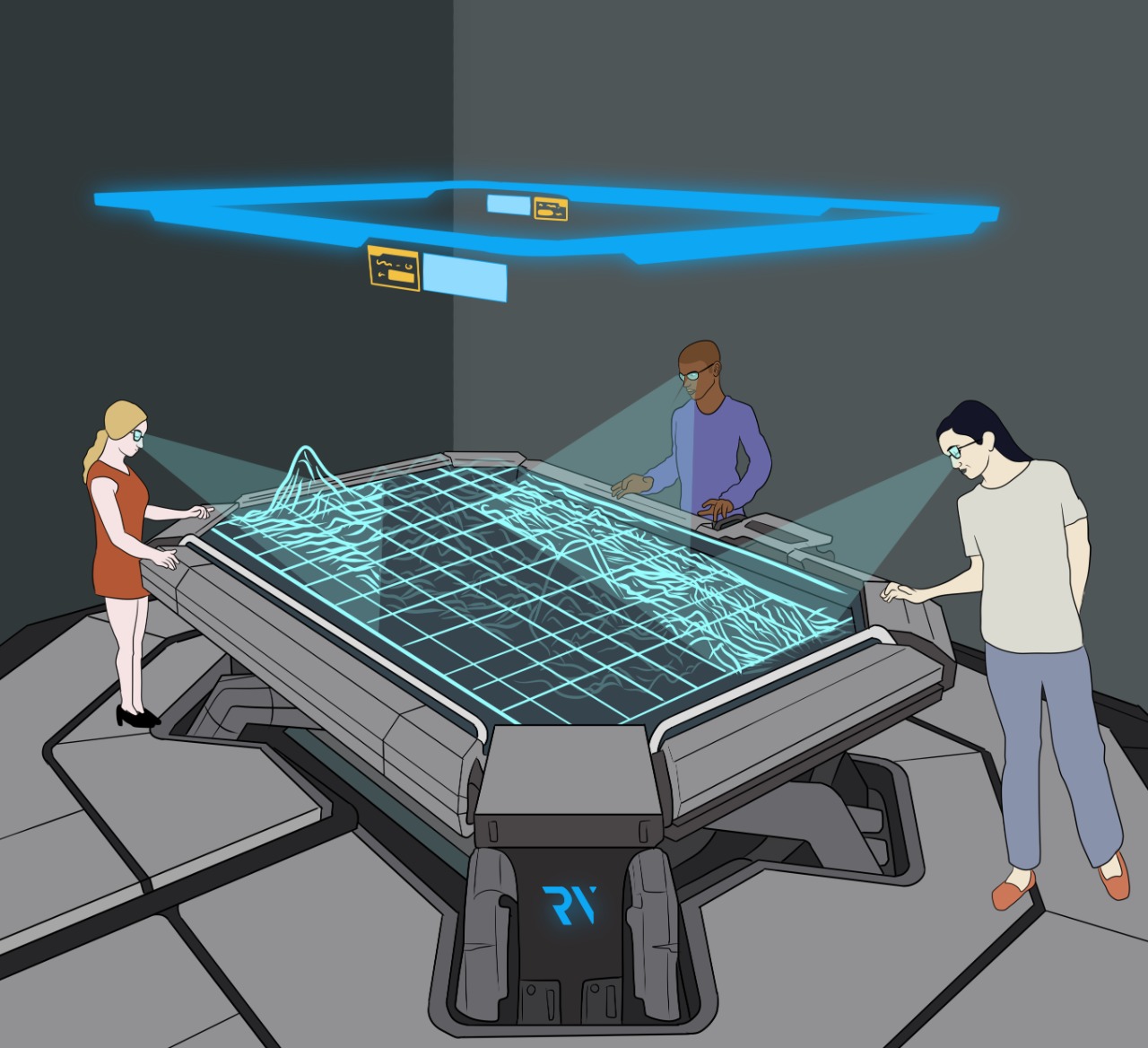
Augmented Reality consists of the direct or indirect view of a virtual object projected onto the real world, augmented with computer-generated elements, involving a range of possibilities such as sounds, computer graphics, and GPS location recognition.
Using a non-invasive mechanism – virtual reality glasses – simply placed in front of the eyes, it is already possible to insert three-dimensional objects, viewed in high resolution. Solutions already available, such as Google's HoloLens, expand the scope of holograms into the world of virtual reality and achieve more success than the "illusionism" techniques used in methods like smoke projection.
The popularization of augmented reality glasses promises to further expand the scope of use and collective immersion in virtual realities. In this way, in a few years, it will be possible to have the real-time presence of speakers, teachers, alternative worlds, and a myriad of new interactions, including (why not?) a training session with a certain Jedi master.